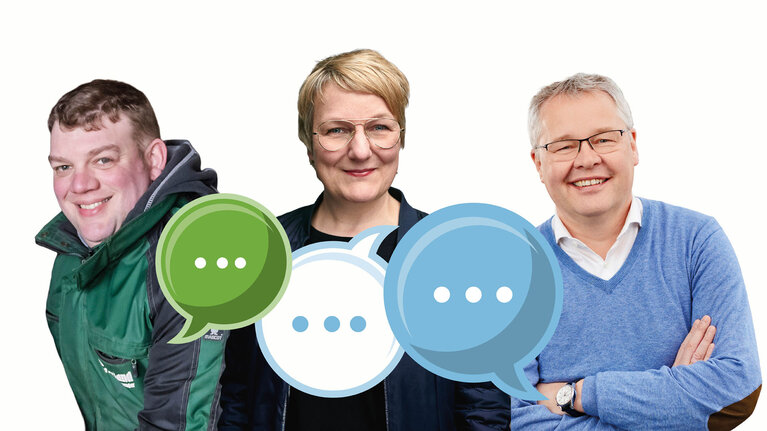
The participants
Agriculture was long seen as a problem sector. Has that image changed – or simply become friendlier?
Thomas Andresen: It hasn’t completely changed. But I believe public trust was always greater than many farmers themselves assumed. For a long time, we focused too much on the loudest critics and concluded that society as a whole was against us. That was a mistake. Most people are far more nuanced. They see problems, yes – but they also recognise that we produce food and carry responsibility.
Kerstin Wriedt: That’s exactly our experience as well. There is no single “society” that is uniformly against agriculture. There are different expectations. Many people want animal welfare, climate protection and regional food supply – while at the same time expecting affordable food and reliable availability. We have to take that contradiction seriously. At the Milk Initiative, our role is not to explain those contradictions away, but to make them understandable.
Ingo Müller: For companies, this means the debate has become more sophisticated. In the past, delivering a good product was often enough. Today, production conditions are evaluated as well. Origin, carbon footprint, animal husbandry, supply chains – all of this increasingly influences purchasing decisions, at least for a growing share of consumers. We need to respond to that without ignoring economic realities.
Mr Andresen, why did so many farmers take to the streets in 2019?
Andresen: Because many farms felt cornered. There were constantly new requirements, new documentation obligations, new debates - but hardly anyone asked what all of that actually meant in practice on a farm. For outsiders, a new law may simply look like a political signal. For a farm, it can mean investment costs, rebuilding work, additional labour hours or genuine existential concerns. Back then, that gap between political decisions and operational reality exploded into public view.
And what remains today – besides images of tractors in front of the Brandenburg Gate?
Andresen: The realisation that we have to explain ourselves more actively. Protest creates attention – but not long-term relationships. Those only develop through conversation.
Wriedt: That really was a turning point. Since then, far more farmers have started speaking publicly about their everyday lives themselves. Not through glossy campaigns, but in their own language. That feels much more credible.
For years, plant-based nutrition was presented as the future. Was that a genuine shift – or more of an urban trend?
Andresen: It was certainly a trend, but not a complete transformation. The numbers clearly show that the vast majority of people still consume animal products. In fact, we are currently seeing rising demand again for dairy products and, in some cases, for meat as well. To put it bluntly: around 95 per cent of people continue buying products from animal agriculture, while only a smaller group consistently avoids them. Even using higher estimates, the number of people living fully vegan lifestyles remains comparatively small. That doesn’t mean alternative diets should be dismissed - everyone should eat the way they want to. But we also shouldn’t pretend the majority has already moved on.
Wriedt: I would add that the success of plant-based alternatives has still changed something important. It accelerated discussions around nutrition, health, climate and ingredient transparency. Consumers now pay closer attention to protein content, processing, origin and the functionality of products. That has made the entire market more demanding. In the end, all categories benefit from that – including traditional dairy products. People choose them more consciously now, reassess them differently and evaluate them more strongly based on their actual value.
Müller: Exactly. Competition from alternatives is not automatically a threat - it also creates pressure to innovate. The key point is that consumers ultimately decide for themselves and that products remain transparently comparable.
Is social media now more influential than agricultural policy?
Wriedt: I wouldn’t pit one against the other. Politics sets the rules. Communication creates understanding. But yes - when it comes to public perception, direct communication channels have become enormously important. When people see what a barn actually looks like, how animals are fed or how decisions are made on a farm, the debate changes immediately. Abstract accusations become concrete questions.
Andresen: And it changes farmers too. Many colleagues only realise through direct interaction with consumers that there isn’t just mistrust - there is also genuine interest. That takes a lot of hostility out of the discussion.
Müller: The same applies to companies. In the past, the focus was more strongly on the end product itself. Today, it’s no longer enough just to talk about quality. We also have to explain how that quality is created – throughout the entire value chain.
Mr Müller, what does that mean specifically for a cooperative like DMK?
Müller: It means we have to fulfil three tasks simultaneously. First: we must provide economic stability for our members in a market that has become far more volatile. Second: we must invest – in efficiency, energy, new products and sustainability. Third: we must communicate and mediate. As a cooperative owned by thousands of farmers, we are not speaking about agriculture from the outside. We are speaking from within it.
”Most consumers want the same things as farmers: good food, fair prices, a healthy environment and a reliable supply.”

”Someone who has never been to a farm views agriculture differently from someone who works in it every day.”

”You don’t have to agree on everything. What matters is whether you’re willing to listen.”

That sounds like a permanent balancing act.
Müller: It is. Consumers expect progress on climate protection and animal welfare. At the same time, many remain highly price-sensitive. Both expectations are legitimate. But we also have to say openly: transformation costs money, time and planning certainty. If we want higher standards, we also need markets that can sustainably support them.
Andresen: And that is exactly where much of the frustration on farms comes from. Many farms are already investing heavily - in modern barns, emission reduction, animal comfort and technology. But if those efforts are barely visible in the market or hardly rewarded financially, the feeling becomes: we are expected to change everything, but no one is willing to support it.
So more is happening on farms than the public realises?
Andresen: Absolutely. Many debates still treat agriculture as though it were static. In reality, farms are constantly evolving - partly out of self-interest. Anyone hoping to pass their farm on to the next generation thinks long-term: about soil, animal health, energy, water and investments. That doesn’t fit the stereotype that farmers only care about short-term profit.
Wriedt: At the same time, change doesn’t explain itself automatically. If things have improved, you have to show it. Otherwise, people continue holding onto images from ten or twenty years ago.
Müller: That’s why standards, certifications and measurable indicators are becoming increasingly important. They make progress visible. The crucial thing is that they remain practical and do not become pure bureaucracy.
Do urban and rural communities understand each other better today – or are they still talking past one another?
Wriedt: Both. The distance has become smaller because there are more direct encounters - digitally and in person. But different realities of life naturally remain. Anyone who has never been on a farm will see agriculture differently from someone who works there every day.
Andresen: That’s normal. We don’t all have to agree on everything. What matters is whether we are willing to listen to one another. And in that regard, we’ve come much further than a few years ago.
Müller: We should also be careful not to romanticise the divide between urban and rural life. Most consumers want the same things farmers want: good food, fair prices, an intact environment and reliable supply. The conflicts usually arise around the question of how all of that can be achieved simultaneously.
What is needed now: fewer rules, more money – or simply more honesty?
Andresen: More honesty would be a very good start. You cannot constantly demand new standards while pretending they won’t affect prices, structural change or imports.
Müller: And we also need reliability. Companies and farms invest for years ahead. If political goals keep changing while the framework conditions are constantly rewritten, it slows down exactly the transformation everyone claims to want.
Wriedt: And we need a new language. Less tribal thinking. Fewer moral snap judgments. More willingness to engage with conflicting objectives. Agriculture is not black and white. It is food supply, nature, economy and cultural landscape - all at the same time.
Where do you see the relationship between farmers and consumers in ten years?
Andresen: I believe it will become more direct and more honest. Less shaped by headlines or outrage, more by real insight. People who see how agriculture actually works tend to judge it more fairly. My hope is for greater trust in the people producing food.
Müller: I expect a more conscious relationship. Consumers will increasingly want to know where products come from, how they are produced and what impact they have. At the same time, reliable food supply will once again be valued more highly. That could create a more stable relationship – if quality and affordability can be brought together.
Wriedt:I hope for greater closeness despite increasing distance in everyday life. Many people will continue to have little direct contact with farms. That makes encounters, transparency and new forms of dialogue all the more important. If we succeed in that, then in ten years’ time we will spend less time talking about one another – and more time talking with one another.

A new openness
The farmers’ protests of 2019 highlighted how great the tensions between agriculture, politics and the public had become. Since then, communication has changed noticeably: farms provide insights into daily life, companies speak more openly about origin and sustainability, and initiatives seek direct dialogue with consumers. At the same time, the conflicts remain: higher expectations around climate protection and animal welfare, pricing pressure from retailers and the question of who ultimately pays for transformation. Trust is not created through campaigns alone. It grows through understandable work, fair framework conditions and continuous dialogue.