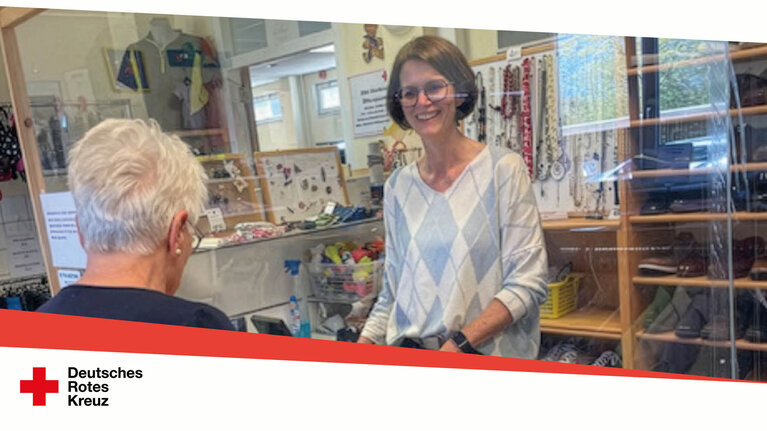
Some people get involved because they were asked – and then simply never stop. Manuela Meyer is one of them. She has been working at DMK since 1988 and is now part of the logistics customer service team in Zeven. Twice a week, she can also be found in a Red Cross clothing shop, ironing shirts, sorting garments – not negotiating prices, but knowing the regular customers. The connection between these two worlds is no coincidence. Spend a little time with Meyer and it becomes clear: she has always been someone who finds it hard to throw things away. Not out of thrift. Out of conviction.
The true value of goods
In DMK’s logistics customer service, Meyer’s day-to-day work revolves around products that no longer fit the standard range. At the production sites in Zeven and Edewecht, items regularly fall just short of the strict requirements of the primary market – slightly damaged packaging, shorter shelf life, batches outside specification. Nothing is thrown away. Instead, Meyer sells these secondary-grade goods to a regular group of specialised buyers – traders and processors who know how to work with second-choice products. Every day, a new list lands on her desk. Which buyer gets which product? What is it worth? What can be negotiated? Meyer decides all of that herself. “A good milk is still a good milk, even if the packaging has taken a knock,” she says. Then there are transport damages. When goods arrive at customers in a damaged state, Meyer assesses who is liable – and allocates the cost accordingly. It’s a judgement call that requires sensitivity: was the driver careless, or is the packaging no longer suited to the demands of the logistics chain? Clear-cut cases are rare. “I get involved, I don’t sit things out – I look for solutions,” Meyer says.
A way of looking at life
This thread – not giving up on things before they’re truly finished - runs through her entire life. Before anything is discarded, Meyer asks herself whether it might still be useful to someone else. It’s not a principle she preaches. Just a way of living that increasingly runs counter to the boom in cheap fast fashion. In the clothing shop, she sees the consequences: the quality of donations has declined as low-cost retailers flood the market. “When you buy something, you should think about whether you really need to follow every trend,” Meyer says. These days, she often checks the shop before buying something new herself. And then there are the customers who show her what reuse really means. One encounter, in particular, has stayed with her: a group of young men from Burundi - one of the world’s poorest countries, which they had fled in search of a future. They came to the shop regularly. No shared language, no familiar home – and yet they were always in good spirits, always modest, always grateful. For an ironed shirt someone else no longer wanted. For a pair of shoes still in good condition. “I still smile when I think of them,” says Meyer. It’s a kind of gratitude that motivates her – that shows what an object can be worth when it ends up with the right person. For Meyer, it’s not a sentimental moment, but confirmation of something she has always believed: things have value, as long as we allow them to.
The most natural thing in the world
Her voluntary work is her balance - and balance shapes who you are. Spending time twice a week in an environment where appreciation is what drives people, working in a team that ranges from 14 to 85 years old, navigating language barriers - all of that stays with you. As a mindset. Sometimes, the circle closes in unexpected ways. When Meyer walks through the warehouse in Zeven, she occasionally recognises familiar faces from the Red Cross shop – and they greet each other here, too, with a friendly “hello”. Meyer likes that her work at DMK is completely different from what she does in the shop. But as she puts it: “Both matter to me – and I would never give one up for the other.”