He took over a farm that few would have wanted to continue in its current state – 80 cows, with no guarantee of success. Today, Hendrik Albers knows every single one by name. A story about passion, farming – and what holds two people together. It’s still dark when Hendrik Albers steps into the cowshed. 5:30 a.m., somewhere between Bielefeld and the rest of the world. Josefa is there too. They work side by side, speaking little at that hour – there’s no need for words when you know what the other is thinking. By seven, the milking is done. Then the rest of the day begins. Albers is 26 and runs a farm he didn’t inherit, but lease. In 2024, he and his partner Josefa Henkelmann, 24, took over a farm near Bielefeld. The previousowner had run it with dedication for many years, but age and illness had eventually taken their toll. A story that had reached its end. The 80 cows were in poor condition, many of them lame. “At the time we took over, each cow was producing around 25 litres of milk a day,” he says. “Now it’s well over 40.”
Choosing a different path
It may sound like a dry figure – but it isn’t. Behind it lie rebuilt cubicles, investments in technology, rethought feeding concepts, bandages and hoof blocks that he has personally fitted to lame animals – “with care”, he says, without irony. Preventive health measures, improved grassland fertilisation, changes in maize cultivation. An entire farm reimagined by two people who had only just graduated and could easily have chosen a secure job elsewhere. With a steady salary. With evenings off. “We wanted to be our own bosses.” That’s far from a given. Rising energy costs, increasing bureaucracy, volatile prices: anyone in their mid-twenties who consciously chooses dairy farming today – when they have other options – is going against the tide.
Following in his father’s footsteps
Albers grew up in the Emsland. His father once ran a dairy farm there – until the milk crisis of 2009, when prices collapsed and he had to sell the herd. What followed was a job in the cable industry; farming continued only as a sideline. “It wasn’t an easy decision for him,” says Albers. A family tradition, broken out of economic necessity. His father is proud today – you can hear it when Albers talks about him. The farm he now runs is in North Rhine-Westphalia. It’s not the family farm. And yet, in a way, he is continuing what his father once had to give up.
The woman who knows cows
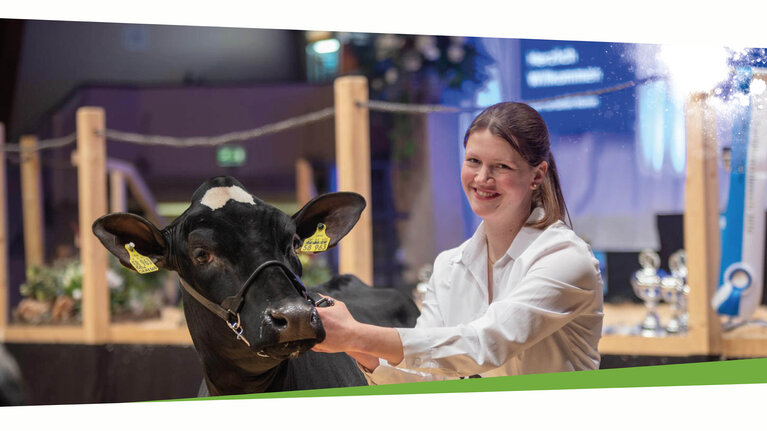
Josefa Henkelmann is not a supporting character, but a second lead. The two met while studying agriculture in Osnabrück and kept crossing paths at livestock shows – a world of its own, with its own rules, aesthetics and passion. Today, Henkelmann sits on the board of a young breeders’ association, teaching children how to present calves and what matters in breeding. She knows the cows just as well as her partner. “What fascinated me from the start,” says Albers, “was her love for the animals and her incredible expertise.” Once, at a show in Italy, they saw a nine-year-old cow – almost biblical in age for a breeding animal – that looked significantly younger. Long neck, a beautifully veined udder, an overall conformation that captivated them both. “An outstanding cow,” says Albers – and at the same time, he’s talking about a subject they could discuss for days.
Dialogue instead of protest
Daily life is long – and rarely easy. Diesel is expensive. Regulations are increasing. Holidays are out of the question. There are no employees. In the evenings, Albers is on the farm until at least 7:30 p.m., often longer. The recent farmers’ protests and tractor demonstrations never quite felt like his approach. “I believe more in dialogue, understanding and transparency,” he says. The vegan trend, he adds, is largely media-driven; most people still consume animal products. But he is equally clear: if you take animal welfare seriously, you have to show it. In the future, they plan to open up the farm, invite visitors and make their work visible.
Like an old married couple
In his herd, there are two cows that are never apart. Always together in the barn, always side by side in the milking parlour. Once, they were separated for two weeks – one became restless, disoriented, somehow lost. When they were reunited, the relief was unmistakable. Like an old married couple. Albers understands that well. There’s comfort in not being alone. A quiet familiarity that grows without you noticing. Shared worries that feel lighter because someone else understands them. When he thinks of those two cows, he can’t help but smile – because he knows exactly what that feels like. And because there’s hardly anything better than not standing alone in the cowshed at 5:30 in the morning.