![[Translate to English:]](https://milchwelt.de/fileadmin/_processed_/1/0/csm_11_Artikelbild_Hoch_176a2ba894.jpg)
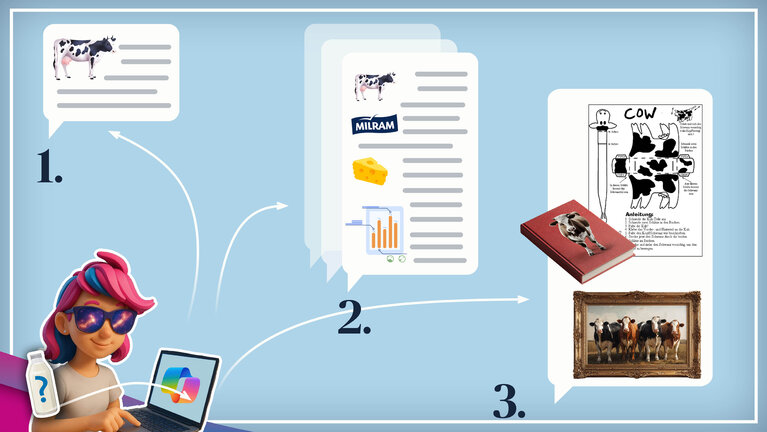
Microsoft 365 Copilot has quietly become part of everyday workflows. It answers employees’ questions, drafts texts, summarises documents and supports research tasks. For Carsten Büttemeier, IT Business Analyst CI, this is not a gimmick but real added value. “Unlike a search engine, Copilot supports tasks with concrete suggestions,” he says. Not just providing information but thinking ahead - that is exactly what many have long wished for. Copilot is part of the company’s digital innovation programme: “Discovery” is driving the use of artificial intelligence across the organisation.
”At DMK, we think broadly. This shows that we are on the move.”

”Unlike a search engine, Co-Pilot makes specific suggestions for a task.”

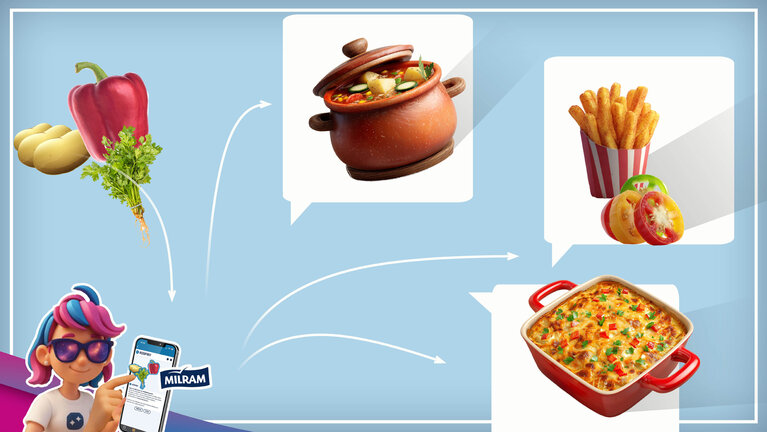
For consumers, a special service tool is in use: the MILRAM Recipe Bot, an AI-supported chatbot that helps website visitors find tailored recipes using MILRAM products. A small tool – but one that demonstrates how broadly AI can be applied today. Not as an end in itself, but as part of a broader transformation that will determine competitiveness. David Reinhardt, Head of Digital Innovation, has been observing this development for years - and senses a new dynamic within the company. “You can feel people’s curiosity,” he says. “Many want AI to support them in their daily work.” Reinhardt, who is responsible for digitalisation at DMK, knows the playgrounds of modern IT technology: machine learning and image recognition, for example. But this time, something is different. The new generation of generative AI tools is bringing areas into focus that were previously considered barely automatable: communication and creative work. “The program is part of the company’s DNA,” says Reinhardt. “And that also plays an important role for young talent.” Modern technology always sends a signal: this is a place where secure, future-proof jobs are being invested in.
Safety in Production
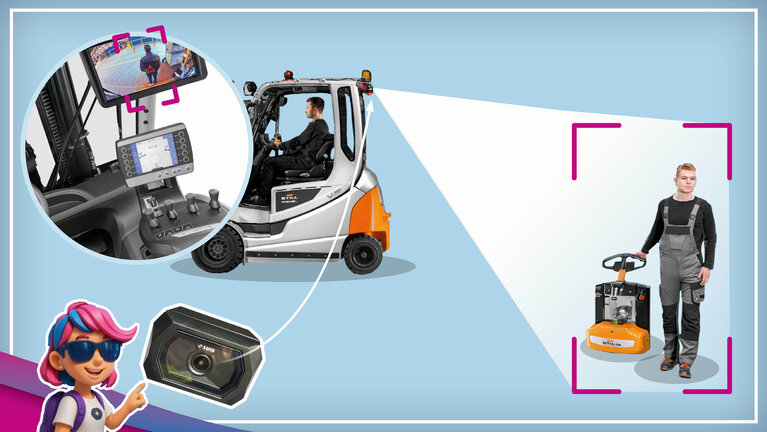
While AI can bring greater convenience in office environments, it can also significantly increase safety in production. At the Zeven site, an AI-based camera system has been introduced on forklifts to prevent accidents. The reason: forklift drivers often manoeuvre heavy machinery on the premises. The system detects people or human-like objects in the rear area of the forklift in real time. Multi-level warning signals appear on an HD monitor in the driver’s cab. If a person comes too close, the forklift automatically slows down. For DMK, this is a test case: using AI not as a cost-cutting tool, but as a protective shield.
Data Protection: The New Baseline
Any company using AI must protect its data. This is no longer just an internal obligation - it is now also the law. The new EU AI Act - unique in this form worldwide – sets clear rules: transparency, fairness and protection against misuse. For DMK, this means AI systems must not only work; they must also be trustworthy.
Smart Farming
Farmers, too, have long embraced AI. While DMK does not develop tools specifically for agriculture, more and more AI helpers are being used on farms in general: chatbots that support farm management, camera systems that monitor animal health, or sensor technology that independently analyses machine data.
And ambitions remain high: why not one day reduce energy costs by having AI dynamically control power consumption? Reinhardt’s team is already exploring such scenarios. “At DMK, thinking is broad,” he says. “That shows we are on the move.” At the same time, he emphasises that efficiency gains through AI should not come at the expense of jobs. That is why every introduction of new tools is closely coordinated with the works council. Fast digitalization – yes. But not at any price. AI, Reinhardt says, is not a project that will one day be completed. It is a tool that - when used correctly - delivers exactly what companies need today: less routine, more ideas. And with that, a piece of the future that has already begun.